Introduction
Data science is no longer limited to writing complex code, managing heavy servers, or moving data between multiple tools. With BigQuery, businesses can store, analyze, transform, and use machine learning on large datasets directly inside Google Cloud. When AI assistance is added to this workflow, data analysis becomes faster, easier, and more practical for analysts, marketers, developers, business owners, and data science learners.
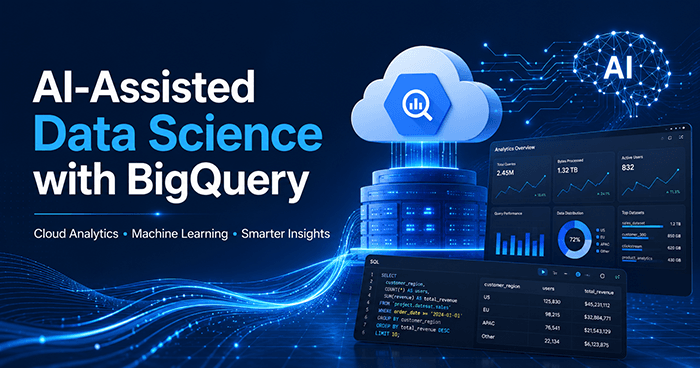
AI-assisted data science with BigQuery means using BigQuery’s powerful data warehouse, BigQuery ML, natural language assistance, machine learning functions, and automation-friendly workflows to convert raw data into useful insights.
What You Will Learn
What is BigQuery?
BigQuery is Google Cloud’s serverless data warehouse and analytics platform. It allows users to store and analyze large amounts of data without managing servers or infrastructure. Businesses use BigQuery to run fast SQL queries, create dashboards, analyze customer behavior, measure marketing performance, and make decisions based on real data.
Simple Meaning
BigQuery is like a powerful cloud-based data engine where you can keep huge data and ask questions using SQL. It gives answers quickly, even when the data is very large.
Why BigQuery is Important
- It can handle very large datasets.
- It works without server management.
- It supports SQL-based analytics.
- It connects with Google Cloud, Looker, Google Sheets, and BI tools.
- It supports machine learning directly inside BigQuery using BigQuery ML.
What is AI-Assisted Data Science?
AI-assisted data science means using artificial intelligence to support different stages of data analysis. Instead of doing everything manually, AI can help users explore data, generate SQL queries, identify patterns, explain results, build models, and create faster insights.
In BigQuery, AI assistance can help users work with data more naturally. For example, a user can ask questions about data, generate query ideas, analyze trends, and use machine learning functions without building a separate data science environment.
Example
Instead of manually writing a long SQL query, a user may ask: “Show me monthly sales growth by region.” AI assistance can help create the query, visualize the result, or suggest next analysis steps.
Key Features of AI-Assisted Data Science with BigQuery
Natural Language Assistance
AI assistance can help users explore data using simple language. This makes data analysis easier for beginners and faster for professionals.
SQL-Based Analysis
BigQuery uses SQL, which is widely used in analytics. Users can filter, join, aggregate, and analyze data with structured queries.
BigQuery ML
BigQuery ML lets users create and run machine learning models using SQL without moving data to another machine learning platform.
Data Visualization
Results from BigQuery can be visualized using connected tools, dashboards, and reports to make insights easier to understand.
Large-Scale Processing
BigQuery can process large datasets quickly, which makes it useful for customer analytics, marketing analytics, finance, operations, and business intelligence.
Python-Friendly Workflows
Data professionals can also use Python-style workflows through BigQuery DataFrames, making it easier to analyze data with familiar data science methods.
Step-by-Step Workflow
A practical AI-assisted data science workflow in BigQuery usually follows these steps:
Collect Data
Data can come from websites, apps, CRM tools, marketing platforms, transaction systems, spreadsheets, or cloud storage. The first goal is to bring useful data into BigQuery.
Clean and Prepare Data
Raw data often contains missing values, duplicates, incorrect formats, or unnecessary columns. Cleaning makes the data ready for analysis.
Explore Data
Users run queries to understand patterns, trends, customer behavior, sales movement, traffic sources, and other important signals.
Use AI Assistance
AI can help generate query ideas, explain results, suggest visualizations, and guide users toward better analysis questions.
Build Machine Learning Models
With BigQuery ML, users can create predictive models for classification, forecasting, customer segmentation, recommendations, and other analytics tasks.
Evaluate Results
After building a model, users check performance, accuracy, errors, and feature importance to understand whether the model is useful.
Deploy Insights
Final insights can be used in dashboards, business reports, automation workflows, marketing campaigns, or decision-making systems.
Real-World Use Cases
Marketing Analytics
Businesses can analyze campaign performance, ad spend, conversions, traffic sources, customer journeys, and return on investment.
Customer Segmentation
BigQuery can help group customers based on behavior, location, purchase history, engagement level, and lifetime value.
Sales Forecasting
Companies can use historical sales data to predict future demand, revenue trends, seasonal patterns, and business opportunities.
Website and App Analytics
Teams can understand user behavior, page performance, conversion funnels, retention, bounce rate, and product usage.
Fraud Detection
Businesses can detect unusual activity, suspicious transactions, abnormal patterns, and risk signals using analytics and machine learning.
Business Reporting
BigQuery can power dashboards and reports for leadership teams, finance teams, marketing teams, and operations teams.
Benefits of AI-Assisted Data Science with BigQuery
- Faster Analysis: AI assistance can reduce the time required to explore data, write queries, and understand results.
- Less Data Movement: Machine learning can be done closer to the data, reducing the need to export large datasets into other tools.
- Beginner-Friendly: Natural language support and SQL-based workflows make data science more accessible to analysts and business users.
- Scalable: BigQuery is designed to handle large data volumes, making it useful for growing businesses.
- Better Decisions: Businesses can use insights from data to improve marketing, sales, operations, and customer experience.
- Integrated Ecosystem: BigQuery works well with Google Cloud tools, business intelligence platforms, and machine learning workflows.
Challenges and Things to Keep in Mind
AI Assistance is Helpful, But Not a Replacement for Understanding
AI can suggest queries, summaries, and patterns, but users must still verify the logic, data quality, model performance, and business meaning of the results.
- Bad data can produce bad insights.
- Wrong assumptions can lead to wrong business decisions.
- Costs should be monitored when querying very large datasets.
- Data privacy and access permissions must be managed carefully.
- Machine learning models should be evaluated before using them in real decisions.
Best Practices
Start With Clear Questions
Define what you want to know before running analysis. Clear questions lead to better queries.
Clean Your Data First
Remove duplicates, fix missing values, and standardize formats before building models.
Use Meaningful Metrics
Focus on business metrics like revenue, leads, conversions, retention, and customer value.
Validate AI Output
Always review AI-generated queries, explanations, and recommendations before using them.
Monitor Query Cost
Use filters, partitions, and optimized queries to avoid unnecessary data processing.
Document Your Workflow
Keep notes about data sources, assumptions, model logic, and business interpretation.
Future of AI-Assisted Data Science
The future of data science is moving toward faster, smarter, and more accessible workflows. AI will continue to help users ask better questions, automate repetitive analysis, generate insights, and reduce the technical barrier for data-driven decision-making.
Tools like BigQuery are becoming more than data warehouses. They are turning into complete data and AI platforms where storage, analytics, machine learning, visualization, and intelligent assistance work together.
Conclusion
AI-assisted data science with BigQuery helps businesses and professionals analyze data faster, build machine learning models more easily, and make better decisions from large datasets. It combines the power of cloud analytics, SQL, machine learning, Python-friendly workflows, and AI assistance into one practical ecosystem.
For beginners, it is a smart way to understand modern data science. For businesses, it is a powerful way to turn raw data into strategy, performance improvement, and growth.
For official details, you can read the Google BigQuery documentation .
Whether you need a professional website, branding, marketing campaigns, business strategy, or live skill training, KritanSkillX is ready to help you move forward.