AI Workflow Automation: How AI Agents Are Transforming Business Workflows
Artificial intelligence is no longer limited to simple chatbot replies. Businesses are now using AI agents to handle real tasks, connect apps, process data, support customers, manage documents, and improve daily operations. This shift has made AI Workflow Automation one of the most important technology trends for small businesses, freelancers, digital agencies, startups, and enterprise teams.
Earlier, automation was mostly rule-based. A user created a trigger, added an action, and the system followed a fixed path. Now, AI agents can understand context, summarize information, make decisions within rules, and move work across different tools. This makes automation more flexible, more intelligent, and more useful for modern business needs.
Why AI Workflow Automation Is Growing Fast
Companies want to save time, reduce manual errors, and serve customers faster. At the same time, teams are overloaded with repetitive tasks like replying to emails, updating spreadsheets, collecting leads, cleaning data, preparing reports, and moving information from one platform to another. AI-powered systems solve this problem by making workflows faster and smarter.
The demand is also increasing because tools like n8n, Zapier, Make, CRM platforms, AI voice tools, and document automation software are becoming more accessible. Even small businesses can now create workflows that were once possible only for large companies with technical teams.
What AI Agents Do in Business Automation
AI agents are software systems that can perform tasks with a certain level of reasoning and context understanding. Instead of only responding to a question, an AI agent can check data, understand instructions, choose the next step, and complete a workflow across connected tools.
AI Workflow Automation for Daily Business Tasks
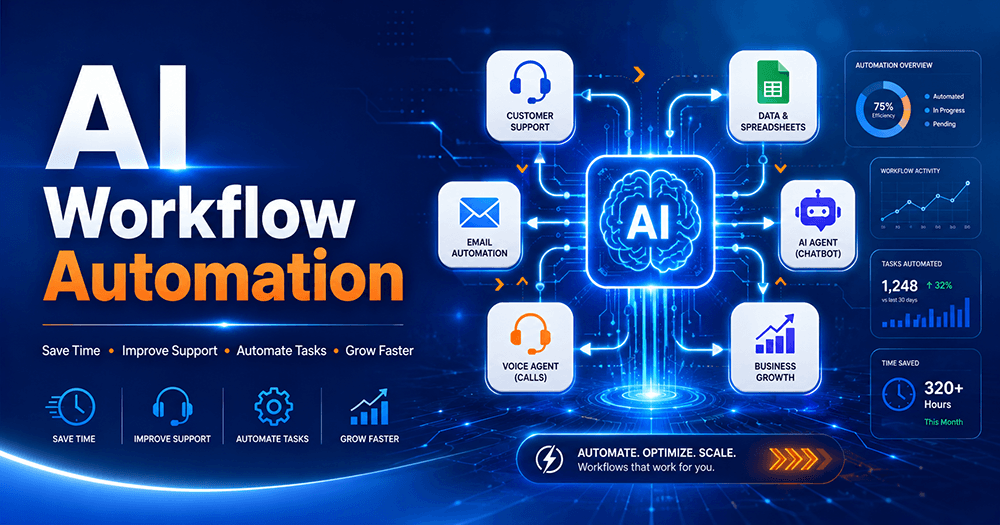
In a business environment, AI agents can help with customer support, sales follow-up, lead qualification, appointment reminders, invoice tracking, internal reporting, and document processing. For example, when a new lead fills out a form, an AI agent can read the details, categorize the lead, update a spreadsheet, notify the sales team, and send a personalized email.
This type of automation is useful because it does not only move data. It can also understand meaning, summarize text, rewrite messages, extract important information, and help teams make faster decisions.
Popular Use Cases of AI Agents and Workflow Automation
Businesses are using AI agents in many practical areas. The best use cases are those where repetitive tasks take too much time but still need accuracy and personalization.
- Customer support replies and ticket summaries.
- PDF, invoice, and document data extraction.
- Excel and Google Sheets automation.
- CRM updates and lead management.
- AI voice agents for calls and appointment booking.
- Email follow-ups and customer communication.
- Marketing reports and campaign summaries.
- Website form automation and WhatsApp notifications.
The main goal is simple: reduce manual work, improve response time, and help teams focus on higher-value decisions.
Tools Used for AI Agents and Automation
Different tools are used depending on the business goal. Zapier is popular for connecting many apps without coding. n8n is useful for advanced workflow control, custom logic, and technical automation. Make is known for visual automation building. Businesses also use AI chat tools, CRM systems, email platforms, Google Workspace, spreadsheets, and customer support software.
AI Workflow Automation Tools for Beginners
Beginners can start with simple workflows such as sending form leads to Google Sheets, creating email notifications, summarizing customer messages, or generating social media captions from a content idea. After learning the basics, they can build more advanced automations with AI agents, API connections, and multi-step workflows.
Benefits for Small Businesses and Digital Agencies
Small businesses often have limited staff and tight budgets. Automation helps them work faster without hiring a large team. A local business can automate appointment reminders, lead follow-ups, review requests, invoice updates, and customer responses. A digital agency can automate reporting, onboarding, client communication, and content planning.
This also creates a strong opportunity for freelancers and service providers. If you learn how to build useful AI automations, you can offer this as a high-value service to businesses that want to save time but do not know how to set up the systems.
- Faster customer response time.
- Better team productivity.
- Reduced manual errors.
- Lower operational workload.
- More consistent business processes.
How to Start With Business Workflow Automation
Start by choosing one repetitive task that wastes time every day. It can be lead collection, email replies, report preparation, spreadsheet updates, or document processing. Then map the workflow step by step. Identify the trigger, the required data, the action, and the final result.
Once the workflow is clear, choose a tool like Zapier, n8n, or Make. Begin with a simple automation and test it properly. Make sure the system does not send wrong messages, duplicate data, or skip important steps. Good automation should be reliable, secure, and easy to monitor.
Common Mistakes to Avoid
One common mistake is automating a bad process. If the original workflow is confusing, automation can make the problem bigger. First, clean the process, then automate it. Another mistake is giving AI too much control without review. Human approval is still important for sensitive tasks like payments, legal communication, customer refunds, and private data.
Businesses should also protect data privacy. AI tools may process customer details, documents, emails, or internal business information. Always use trusted tools, clear permissions, and proper access control.
Conclusion
AI agents and automation are changing how businesses work. From customer support and data cleaning to PDF automation, Excel workflows, voice agents, and CRM updates, smart systems are helping teams save time and improve efficiency. AI Workflow Automation is not just a technology trend; it is becoming a practical business growth tool.
The best way to begin is simple: choose one repetitive task, map the workflow, test a small automation, and improve it step by step. Businesses that adopt smart automation early can work faster, serve customers better, and build more scalable operations.
Outbound Link: Read business automation statistics on Zapier
Whether you need a professional website, branding, marketing campaigns, business strategy, or live skill training, KritanSkillX is ready to help you move forward.